
Distribution of the Hagoromo Legend in Asia
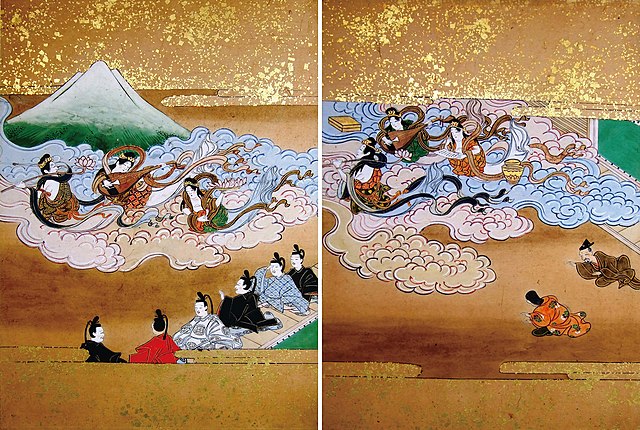
Humans have created myriad stories about heavenly nymphs, a symbol of beauty serving gods in heaven and who occasionally descend to earth and surprise people with various miracles, since ancient times. In particular, the “Hagoromo legend,” a genre of folktale wherein a heavenly nymph wearing a magical hagoromo (feather robe) descends on the human world, has been handed down in numerous versions throughout Asia, including China, India, Japan, Korea, and various parts of Southeast Asia.
Previous studies have presented several classifications of the Hagoromo legend’s storyline, which varies depending on place. However, they have two common elements: 1) the origin of the story in which “a heavenly nymph descends to earth, but she cannot return to heaven because her feathered robe is hidden.”; 2) the supernatural power whereby “the family into which the heavenly nymph marries gains great wealth.” The ending of the story can be largely divided into two types: 1) “the type of ascension” where the nymph finally finds her robe and returns to heaven.”; 2) “the type of living on the earth” in which the nymph dedicates her whole life to the human world. Regarding her relationships with humans, there are several patterns such as “marrying a man and then having children” or “living with an elderly couple as their adopted daughter.” Of particular significance is the wealth generated by the nymph’s supernatural power related to rice harvests, such as the episode “rice in a granary never runs out after they got married.” Furthermore, there are many other legends related to the feather robe legend, such as the Chinese Tanabata legend and the Seven Stars Ancestor Legend, as well as Buddhist tales(Kimishima 1999, Momose 2013).
The question then arises as to why and how these Hagoromo legends spread so widely across Asia. Could it have been due to the mass migration from mainland China, the spread of rice farming, or the expansion of Buddhism? Surely there must have been multiple routes: It is, at least, certain that the image of the heavenly nymph has a deep affinity with the noetic world of Asian people as a fantastic medium connecting them with the physical world. Heaven and earth, humans and nature—to understand the mysterious power of this world, they might have created the imaginary being as an essential medium for communicating with the greatness of nature.
However, not all of these legends have been passed down as idyllic folktales. Mythologist Taryo Obayashi takes up the Hagoromo legend in the Amami and Okinawa regions and suggests that it can be divided into two types: “Dynastic myth” and “Folk myth” (Obayashi 1989). In his view, the dynastic myth uses the human-nymph marriage tale in the context of deifying the local king’s ancestors as a device for maintaining social order between rulers and people. As these narratives have been widely seen, especially in Java and Bali (Indonesia), it would be prudent to consider their connection to the history of nation-building and territorial expansion in ancient Asia.