
The Sri Tanjung Story
5.1. Two Manuscripts from East Java and Bali
The first person to introduce the Sri Tanjung story in book form was Indonesian scholar Prijono, whose book Sri Tañjung: Een Oud Javaansch Verhaal (written in Dutch) was published in 1938. Prior to Prijono’s book, there were two manuscripts of the Sri Tanjung story. One is the palm leaf manuscript called lontar, written in Middle Javanese in Balinese script, which was discovered in Bali and is currently kept in Leiden University Library. Prijono’s book mostly consists of the Romanization and translation of the Balinese manuscript by the author, but Prijono used multiple manuscripts, including paper copies (see 6-3). The other manuscript is a handwritten booklet that was discovered in Banyuwangi in eastern Java. Interestingly, it is written in New Javanese but uses Arabic characters. The booklet, which is also called “the Sri Tanjung lontar” in Indonesia, was formerly kept at the Blambangan Museum in East Java, but the current location is unknown. The manuscript has been studied by the research group in Jakarta (Aminoedin et al. 1986) and the e-book by East Javanese researcher Wiwin Indiarti (Indiarti 2020).
Considering this history raises a key question: When and where was the Sri Tanjung story created? Today, it is widely believed that the story originated in Banyuwangi, East Java. In fact, Prijono’s book is one of the sources, though he assumes this based on the discourses of western scholars in the 19th century (see 6-3). Further research will be needed to identify the origin of this story solely from the Balinese palm leaf manuscript and the East Javanese booklet. It is a certainty that the story was widely shared in the medieval societies in East Java and Bali, with great importance placed on the local noetic world of that time. From this perspective, it is important to recognize the Sri Tanjung story as being among the cultural heritages of the medieval Hindu Javanese period that have been transmitted in various forms in each region.
5.2. The Storyline
In his 1938 work, Prijono summarized the Sri Tanjung story in the Balinese lontar as follows (written in Dutch in the prose version).
- Sidapaksa, a vassal of King Surakrama of the Sinduraja Kingdom, visits the ascetic training seminary Prangalas at the foot of the mountain. He is in search of medicinal herbs that can cure headaches at the command of the king. There, Sidapaksa is captivated by the beauty of Sri Tanjung, the adopted daughter of the sage Tambapetra, and falls in love with her. As the daughter of a goddess, Sri Tanjung supports the sages at this ascetic training seminary, which lies on the border between the heavenly and human worlds. Sidapaksa proposes to Sri Tanjung and brings her back to the capital as his wife.
- The news that Sidapaksa has married a beautiful woman spreads throughout the capital. King Surakrama becomes jealous and plots a conspiracy against Sidapaksa, ordering him to obtain three treasures from the gods who live in heaven. Upon receiving the king’s command, Sidapaksa is confused, as he does not know how to complete the task. Seeing this, Sri Tanjung offers Sidapaksa a secret item that she inherited from her father in heaven. It is a magic feather robe that enables one to fly. Sidapaksa immediately puts on the robe and sets off for heaven. Hearing that Sidapaksa has left the capital, King Surakrama visits Sri Tanjung as planned and attempts to seduce her in various ways. However, Sri Tanjung stubbornly refuses. The king, feeling humiliated, returns to the palace. Meanwhile, Sidapaksa, who has arrived in heaven, succeeds in obtaining the three treasures desired by the king with the help of the gods sent by the sage Tambapetra. He returns to the capital with a sense of accomplishment.
- Sidapaksa meets the king and presents him with the three treasures. However, instead of praising him for his great achievement, the king tells him the lie that Sri Tanjung has been unfaithful in her husband’s absence. Deeply shocked, Sidapaksa rushes home and blames Sri Tanjung, ordering her back to the mountain. Sri Tanjung consistently protests her innocence and finally entreats Sidapaksa to just kill her if their love falls into such misery.
- Unable to find a solution, the two head to Gandamayu, a cemetery in a forest. Sri Tanjung kneels and imparts her last words to Sidapaksa: “If I am innocent, my blood will smell sweet.” In fact, soon after Sri Tanjung takes her last breath from Sidapaksa’s dagger, a fragrant smell spreads from the blood flowing from her body. Realizing his irremediable sin, Sidapaksa breaks down in tears.
- When Sri Tanjung’s soul reaches the world of the dead, the first thing she sees is a great river. Sri Tanjung is confused, so when a white crocodile with a demonic head comes to her, she says, “I don’t know how to cross this river, so please tell me.” The crocodile pops its head out of the water and replies, “I will be your iron bridge.” Once Sri Tanjung has crossed its back to the “Swinging Bridge” on the other side, the crocodile leaves.
- As Sri Tanjung carefully crosses the Swinging Bridge, she sees eerie beasts of the underworld and myriad sinful souls suffering in eternal hell. Trembling with fear, she reaches the gates of Dorakala, Queen of the Underworld. However, Dorakala, who knows about Sri Tanjung’s innocence and death, offers words of mercy. After posing witty questions, Dorakala is amazed by the intelligence of Sri Tanjung, who responds with satisfactory answers. Finally, Dorakala sends Sri Tanjung’s soul back to earth, saying, “You should not die yet.”
- Sri Tanjung’s soul returns to her body in the forest, Gandamayu. Suddenly, a goddess who rules over Gandamayu appears, saying, “Long ago, your father was tied to a tree and was on the verge of death, but he retrieves my original figure from me [in] the form of a monster (Note),” proceeding to revive Sri Tanjung’s body. Revived with greater beauty, Sri Tanjung returns to her hometown of Prangalas accompanied by the goddess’s servant, Kalika. In a tearful reunion with her family, including Tambapetra, Sri Tanjung reveals the whole story. Feeling deep sympathy, Tambapetra exerts himself in conducting a purification ritual for her with all his heart. As a result, Sri Tanjung becomes more beautiful than ever and incomparable with any other nymphs in the heavens.
- Meanwhile, Sidapaksa, who is in a state of desperation due to his own guilt, visits Gandamayu, where he spent his final moments with Sri Tanjung. He then lies down in the dark forest waiting for death as a means of dedication to Sri Tanjung’s soul. Feeling deep pity for his appearance, the goddess of Gandamayu appears before him. The goddess tells him of Sri Tanjung’s revival and return to Prangalas, informing him of Sri Tanjung’s statement: “I will be with Sidapaksa again if King Surakrama is killed.” Sidapaksa, who has regained his senses following this revelation, immediately sets off for Prangalas after paying his utmost respects to the goddess.
- Sri Tanjung is upset when she hears of Sidapaksa’s arrival and continues crying in her bedroom, experiencing conflicted emotions between love and justice. She finally tells Tambapetra through her mother Sri Wani, “When I can put my foot on the king’s head, I will see him again.” Hearing this from Tambapetra, Sidapaksa decides to confront the evil of King Surakrama, who had betrayed him and his wife. He calls upon the sages and gods of Prangalas and then flies to the capital in the magical feather robe.
- After a fierce battle, Sidapaksa and his army finally surround the palace. King Surakrama ultimately admits defeat and is beheaded, after which his head is wrapped in a yellow cloth and placed in a coffin. A rumor that Sidapaksa will become the next king proceeds to spread throughout the capital.
Regarding the Sri Tanjung manuscript from Banyuwangi (a paper booklet written in Arabic characters) the research group in Jakarta represented by Aminoedin provides detailed information. Their research reveals the same storyline as the Balinese version, though there are some differences such as adoptions of Islamic concepts (Aminoedin et al. 1986). On the other hand, many of today’s versions in Javanese plays (ketoprak) and picture books omit or modify the cruel final scene. The Sri Tanjung story does not include the typical scene in which “a man hides a nymph’s feather robe when she is bathing” in the “Stolen Clothing” legends. However, given the series of descriptions in which Sri Tanjung is a daughter of a heavenly nymph and bestows her feather robe upon her husband, this story would have been transmitted as a nymph legend.
(Note) This is thought to be related to the Sudamala story, which prevailed in East Java and Bali during the Majapahit period. The story starts with the episode in which the goddess Uma is transformed into Durga, the witch of Gandamayu, by the wrath of the god Shiva. She finally regains her original beautiful figure by the power of Sadewa (the youngest son of the Pandawa royal family), who was offered as a sacrifice. Since Sadewa marries one of the daughters of the sage Tambapetra, Sri Tanjung is thought to be Sadewa’s daughter. In addition, although the name “Durga” is not actually used in the Sri Tanjung story, “Kalika” appears as Durga’s servant in the Sudamala story. (Kalika is the witch who accompanies the revived Sri Tanjung on her return home.) However, “the flying feathered robe as Sri Tanjung’s heirloom” in the Sri Tanjung story does not appear in the Sudamala story. Although some uncertainties remain, the Sri Tanjung story is assumed as a sequel to the Sudamala story by the linguist Van der Tuuk, who first collected the Sri Tanjung manuscripts from Bali, and Prijono, who transcribed them into a book (van der Tuuk 1881; Prijono 1938).
5.3. Transmission of the Sri Tanjung Story: Region and Style
The Sri Tanjung story is inscribed in the two aforementioned manuscripts: a paper booklet in East Java and a palm leaf manuscript (lontar) found in Bali. Generally, the story is believed to have been created in Banyuwangi, East Java. Therefore, the city of Banyuwangi is home to “Sri Tanjung Park (Taman Sri Tanjung)” and the annual Banyuwangi Festival, where people enjoy dances and plays portraying the Sri Tanjung story. There is also a train named “Kereta Sri Tanjung” that connects Yogyakarta and Banyuwangi.
In Java, the most common form of performing arts for the Sri Tanjung story is a type of popular theater called ketoprak. Regarding the paper manuscript/booklet of the story, written as metrical poetry in Arabic character and studied by Aminoedin’s team, it seems to have been recontextualized after the Islamization of Java for reciting the kidung (ritual song) of the Hindu-Javanese vestige within Islamic events. However, there is still room for further research regarding its cultural contexts and practitioners.
In the case of Bali, following the original aim of lontar/palm leaf manuscripts, the text of the Sri Tanjung story in metrical form has been recited as a kidung in Balinese-Hindu rituals. However, the story is not well known in Bali today since the original manuscripts are kept in Leiden University Library and Priyono’s Dutch-language book is incomprehensible to Balinese locals. Still, according to my interviews in Gianyar in 2018, it was performed several times in Balinese popular theater (arja) in the 1960s. Today, moreover, one can watch several videos on YouTube where local performers recite the Sri Tanjung story in a free-verse style called geguritan.
These facts show that the Sri Tanjung story has not been completely forgotten in Bali but retains the potential to be revived in various forms. For example, the project “How to Recite the Pupuh Wukir/Adri” in 2023 (see Section 7) is an attempt to excavate bodily memory in Bali. The video produced in this project combines the Sri Tanjung poetry in kidung form with children’s theater and is available to view on YouTube, demonstrating the potential to revive the story in various forms of Balinese performing arts.
5.4. Depictions on Relief of Candi (Temple Ruins)
There are various stone monuments in Indonesia, centering on the island of Java, which are generally called “candi” and are vestiges of pre-Islamization culture. Well-known examples are the UNESCO World Heritage sites of Borobudur and Prambanan located near Yogyakarta in Central Java. Some candi in East Java are believed to include depictions from the Sri Tanjung story on the relief: Candi Penataran in Blitar, Candi Bajang Ratu in Mojokerto, Candi Surowono in Kediri, and Candi Jabung in Probolinggo Regency (see My Map).
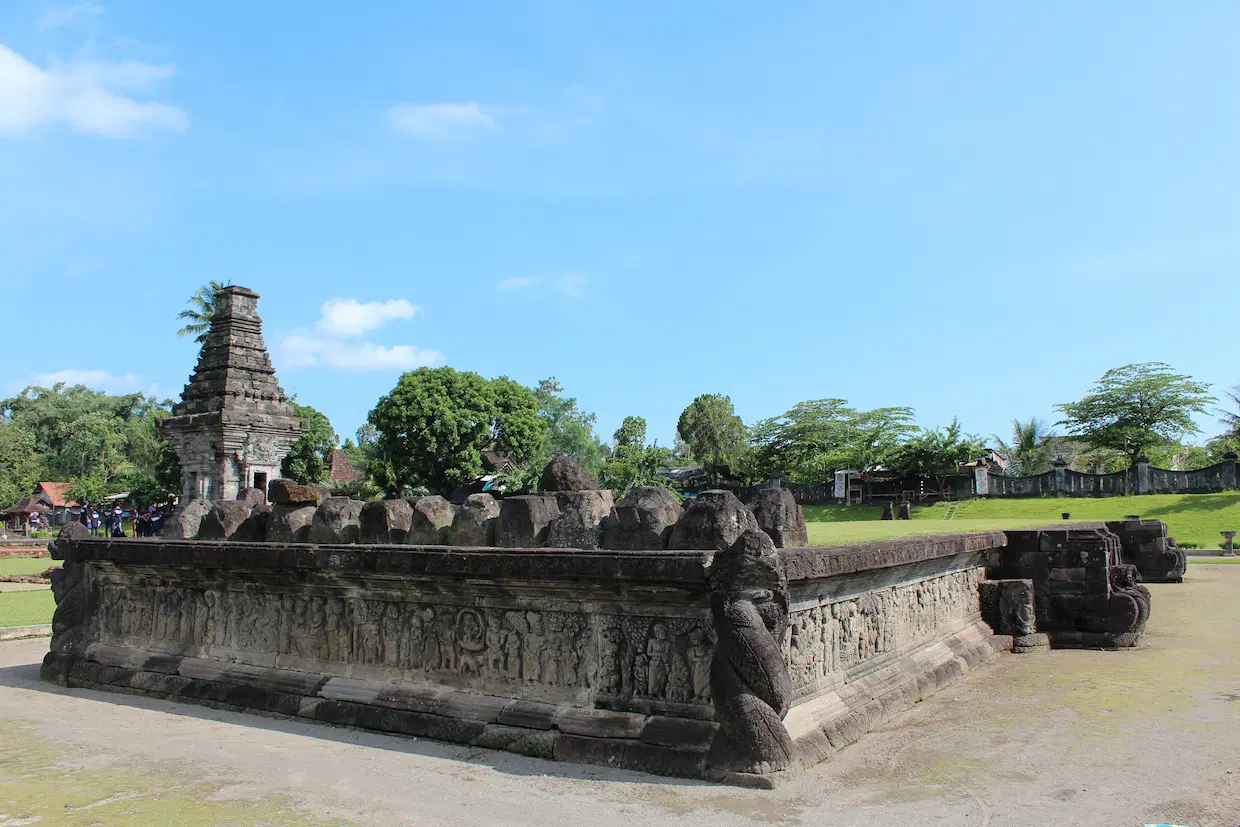
The scene of Sri Tanjung at Candi Penataran is not included in the main temple but on the wall of a rectangular platform called Pendopo Teras (Photo 5-1) near the gate. It depicts a woman at the water’s edge, straddling a large fish with her legs exposed, facing a man sitting cross-legged on the bank (Photo 5-2). The Candi Bajang Ratu is also said to include a part of the story (Photo 5-3), but it is difficult to identify because the relief is positioned at a high position on the wall. The relief at Candi Surowono (Photos 5-4, 5-5) depicts a woman who looks backward while straddling a fish, though it does not include a man as in the case of Candi Penataran. The depiction at Candi Jabung (Photo 5-6, 5-7) also depicts the same female figure as that at Candi Surowono , though the fish depicted at the Candi Surowono is the largest and is reminiscent of the “fish with devil’s face” described in lontar (see section 5-2).
However, this interpretation needs further investigation. When I attended a lecture on the relief of Candi by a foreign iconographer at Universitas Negeri Surabaya in 2018, a local attendee stated: “I am not sure why the relief depicting a woman riding a fish is related to the Sri Tanjung story since the manuscript describes that ‘Sri Tanjung used a crocodile as a bridge to cross the river.’” This is an issue that I also have also pondered, but there was no clear answer from the speaker. In fact, it corresponds with the Balinese Sri Tanjung manuscript transcribed by Prijono, as the scenes in No. 121 and 122 of Chapter 5 include the word “bajul (crocodile)” in Middle Javanese (Prijono 1938: 36–37).
It remains unclear how these images became associated with the Sri Tanjung story, though it would appear that Satyawati Suleiman’s 1967 Monuments of Ancient Indonesia introduced the motif of the fish in the relief at Candi Penataran. However, it is likely that this interpretation was shared among colonial philologists and archaeologists in the first place. It thus suggests the significance of reconsidering the interpretation; namely, whether the woman is from the Sri Tanjung story or another folk tale that was widespread in medieval East Java. It would not be surprising if the symbolic image had great significance in the cosmology of the time, connecting the two realms of water and land mediated by a woman on a fish.
5-1 Pendopo Terrace at Candi Penataran(Blitar)
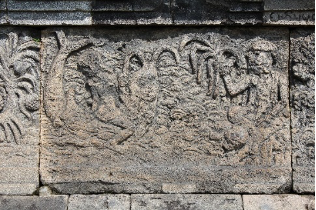
5-2 The image of Sri Tanjung on the relief of Pendopo Terrace at Candi Penataran
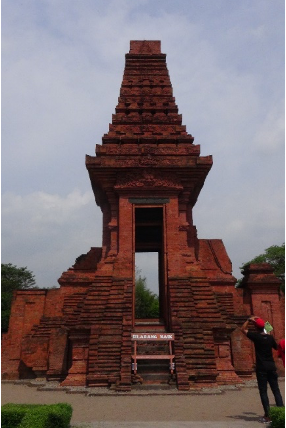
5-3 Candi Bajang Ratu(Mojokerto)
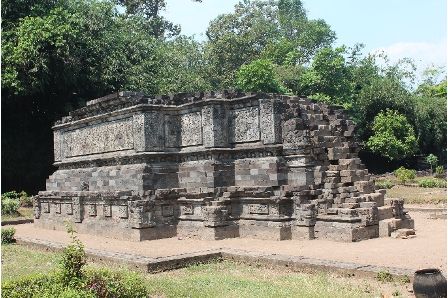
5-4 Candi Surowono(Kediri)
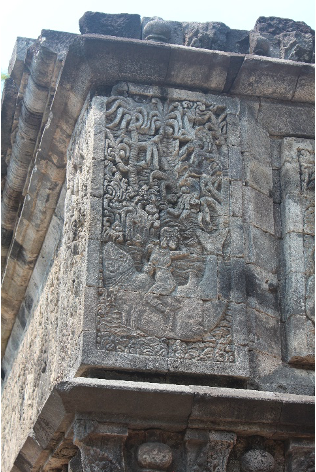
5-5 The image of the Sri Tanjung on the relief of Candi Surowono
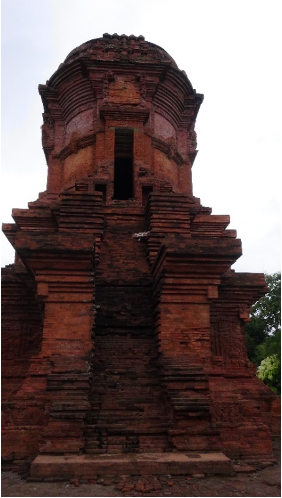
5-6 Candi Jabung(Probolinggo)
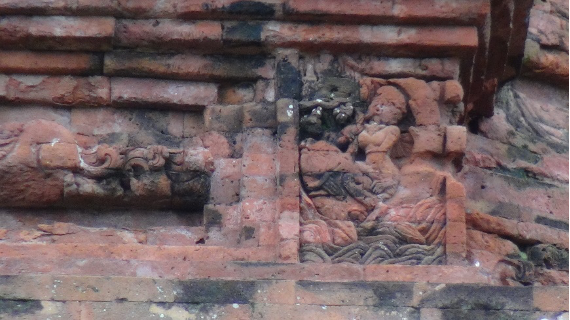
5-7 The image of the Sri Tanjung on the relief of Candi Jabung