
Heavenly Nymph Tales in Indonesia
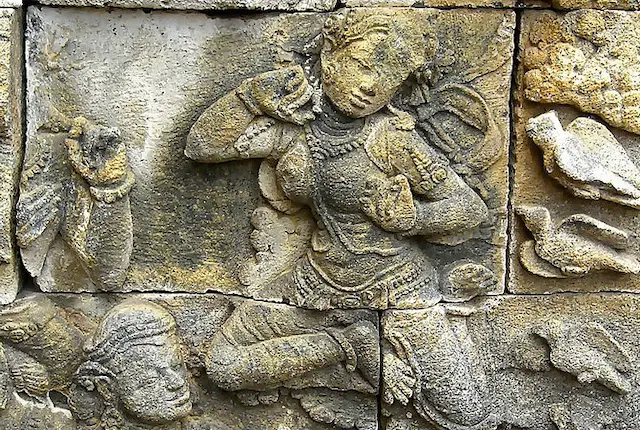
Yuko Momose introduced an extensive study on Indonesian folktales, including heavenly nymph tales (the following being based on Momose 2013: 186–205). While the term “heavenly nymph” is termed “bidadari” in Indonesian, it has various local names in regional languages (such as “dedari” in Balinese). According to Momose, “Hagoromo-like tales are found throughout Indonesian archipelago, from Aceh in the west to Papua in the east. It thus makes Indonesia one of the world’s most prolific producers of nymph tale.” She also states, “Although there are minor differences in the details, these tales share the core of the story that a nymph marries a man living on earth but finally returns to another realm (often to heaven).”
Momose classifies the basic structure of Indonesian heavenly nymph tales into the following scenarios, listed from A to E.
A=A young man steals the so-called hagoromo/feather robe, or wings, of a heavenly nymph who has descended from heaven to bathe.
B=The young man marries the nymph, who is unable to return to heaven.
C=They have children.
D=The nymph finds her feather as the result of an incident and returns to heaven.
E=Various epilogues
Most versions of the story follow the order ABCD, as seen in famous Javanese folktale Joko Tarub. However, Momose assumes that it is the episodes of E that make up the rich variation in Indonesian local folktales. For example: “The husband, who chases after his wife (nymph) and children . . . solve[s] some difficult tasks given to him in heaven and brings his family back to heaven (Southeast Sulawesi).” “Three children who are chasing after their mother in the sky fail to ground along the way; each of them becomes the king where they fall (North Sulawesi).” “The nymph returns to heaven with her children. But when they grow up, they descend to earth to find their father and bring him back to heaven (West Sumatra).” “There was a kingdom where people were banned from raising black chickens, because the king’s wife (nymph) disappeared by finding her magical robe in a pile of rice husks being picked by a black chicken (South Kalimantan).” “The king remarries after his wife (nymph) [returns] to heaven and their three children are abused by their stepmother (Bali).”
One can also perceive diversity in the characters. Most of the young people who steal feather robes are commoners (e.g., farmers, hunters, and fishermen), but there are also noble people (e.g., kings and princes) or strangers (e.g., travelers and wanderers). As for the heavenly nymph, there are exceptional versions who have the nature of a bird, fish, or snake, despite their appearance as beautiful women. The story usually begins with the descent of heavenly nymphs in a group of three, four, seven, or ten, with the most common number being seven. Furthermore, the places where they descend are mainly near water features such as lakes, ponds, rivers, and springs deep in the forest.
There are many other tales related to heavenly nymphs in Indonesia, but Momose categorizes them into three categories:
① The folktale type that follows the standard of Hagoromo tale
② The kingdom myth type that includes episodes of state building
③ The genesis type as part of a narrative about the creation of the world or natural phenomena
The above includes an additional element of ③ based on Obayashi’s two categories— “Dynastic myth” and “Folk myth”—that he discerned in the Hagoromo legends of the Amami and Okinawa regions. This perspective would be useful to analyze various heavenly nymph tales not only Indonesia but in Asia. Significantly, the social contexts of heavenly nymph tales in each region are shaped into the above three types, intertwined with minor elements such as the attributes of the young man and the places where the nymphs descend. This classification will also support examination of the case of Bali introduced in Section 4.