
The Collaborative Project in Bali: “How to Recite the Sri Tanjung in Pupuh Wukir/Adri”
7.1. Purpose
This project was carried out as part of the Japan Society for the Promotion of Science’s Grants-in-Aid for Scientific Research (C), “Archiving Intangible Culture for Living Heritage: Bodily Transmission of Heavenly Nymph Tales in Bali” (Principal Investigator: Nozawa Akiko, Grant Period: April 2019–March 2024, Grant Number: 19K00249).
The idea of this project emerged during research on the Sri Tanjung story, wherein I realized that early 20th century philologists, including Prijono, had neglected the oral tradition of lontar. They made a great contribution to the preservation of cultural heritage by transcribing the original texts of lontar into printed books and reproducible records open to the public. Nevertheless, sound recording and filming technology was not yet common at the time. That is why colonial scholars left behind only a small number of audiovisual materials related to the Hindu-Javanese cultural heritage.
In this project, therefore, we attempted to revive the oral tradition of the Sri Tanjung story by utilizing Prijono’s philological work and modern digital technology. Doing so produced a collaborative film as part of an anthropological praxis to promote the value of the “living heritage” of Hindu-Javanese culture, as well as to activate local cultural transmission by sharing it online.
7.2. Process
This project was carried out over one year from April 2023 to March 2024, with local facilitators Mr. Made Agus Tisnu (principal of Sekolah Bali Q_ta), Mr. Wayan Adi Wardana, and other colleagues, as well as academic collaborators of the school, Mr. Kadek Widyana and Ms. Komang Sukar Marhaeni (the National University of the Arts of Indonesia, Denpasar campus).
We aimed to revive the oral aesthetics of the Sri Tanjung lontar of Bali through the bodily knowledge of local people. The team reached out to local kidung specialists through their networks, which finally resulted in ten singers who could sing the Sri Tanjung poetry in “Pupuh Wukir/Adri” (see 6-3).
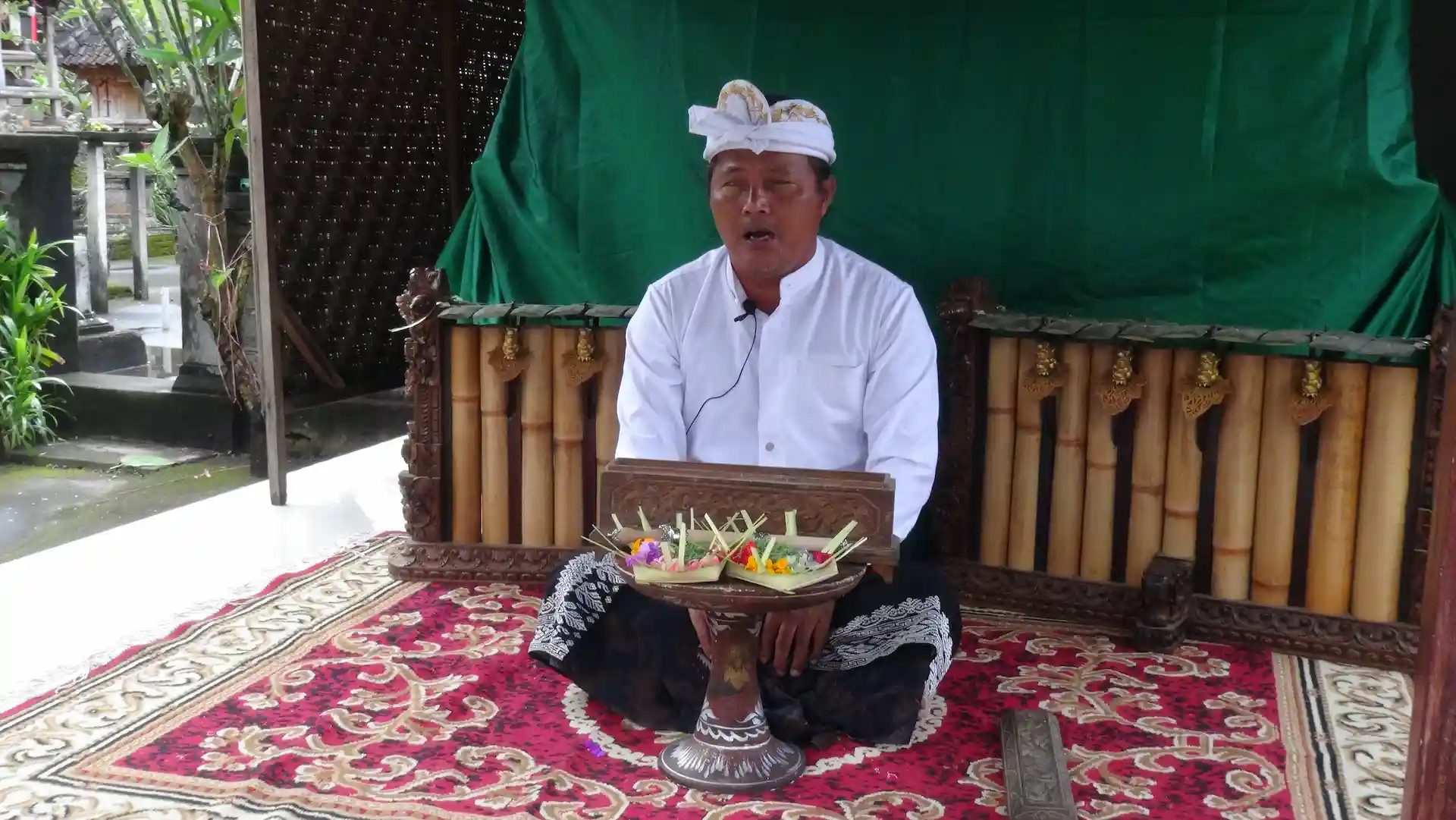
As the first step, Balinese wayang spetialist Mr. Kadek Widyana, who has rich knowledge of archaic texts of the Hindu-Javanese period, selected ten verses from the lengthy original text of Sri Tanjung that were suitable for filmmaking. After assigning the verses to the ten singers, local members visited their houses and filmed their recitations in Pupuh Wukir/Adri via smartphones (Photos 7-1, 7-2, 7-3, 7-4).
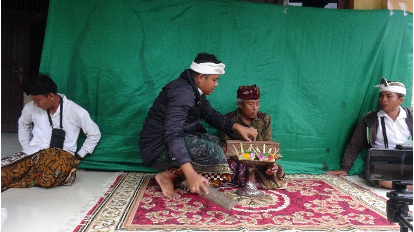
7-1 Recording Scene 1
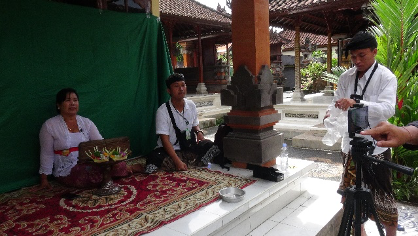
7-2 Recording Scene 2
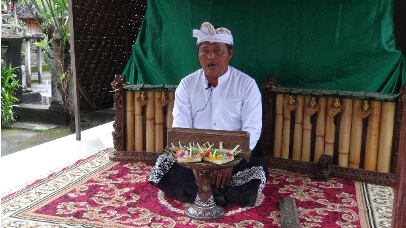
7-3 Kidung recitation by Mr. Wayan Pinda
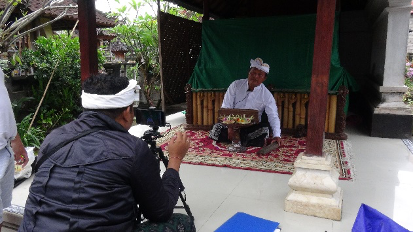
7-4 Recording Scene 3
[Collaborators]
Project Facilitator:Mr. I Made Agus Tisnu, S. Pd. H
Production Team: Sekolah Bali Q_ta
Academic Collaborators:Mr. I Kadek Widnyana, S. Si., M. Si (ISI Denpasar)
Ms. Ni Komang Sekar Marhaeni, SSP., M. Si (ISI Denpasar)
Recording Collaborators (Balinese kidung singers): Ms. Gusti Ayu Kusumawati, S. Pd., M. Pd, Ms. Ida Ayu Nyoman Swarsini, Mr. I Made Arsana, Ms. Ni Ketut Suartini, Mr. Jero Wayan Mugleng, Mr. I Ketut Raman, Ms. Ni Made Sari, Mr. I Nyoman Karya, Ms. Ni Made Tariani, and Ms. Ni Wayan Candri.
7.3. Editing and Distribution
Based on the idea of the local team, the recordings of Sri Tanjung recitation by ten singers were combined with a filmed Sri Tanjung play (silent drama) by selected students of Sekolah Bali Q_ta (Photos 7-6 and 7-7).
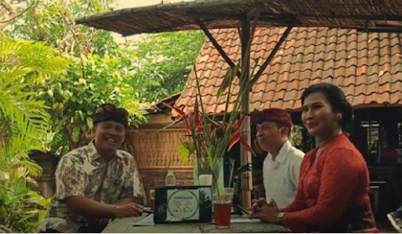
7-5 Mr. Agus (left), Ms. Komang (front right), Mr. Kadek (back right)
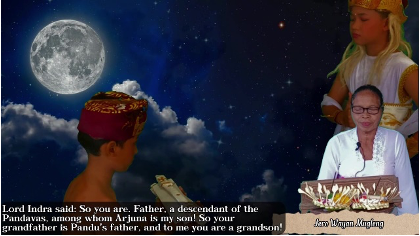
7-6 A scene from the video (Sidapaksa meets Dewa Indra in the sky)
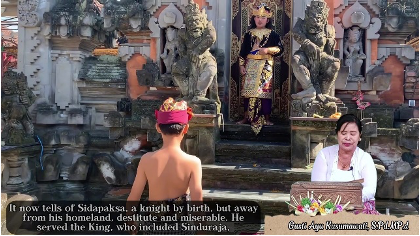
7-7 A scene from the video (Sidapaksa visits the king`s palace)
The combined video begins with a dialogue between Agus, Kadek, and Komang(Photo 7-5). Led by Agus, they exchange information on the background of the Sri Tanjung story of Bali, such as the original lontar manuscripts kept in the Netherlands and the Dutch transcription in Prijono’s book. The discussion leads to a shared view on the significance of transmitting bodily knowledge of traditional culture, introducing the project “How to Recite the Sri Tanjung in Pupuh Wukir/Adri” as an example. I was amazed by the creative idea of the beginning given that it is so appealing and easy for children to understand owing to the long experience in primary education of Agus and his colleagues at Sekolah Bali Q_ta.
The collaborative video of the Sri Tanjung performance by children and 10 kidung singers then begins. (Translations of the lyrics by each singer are included in the video below.)
After the performance, the topic returns to discussion between Agus, Kadek, and Komang, who talk about both the aesthetics of the Sri Tanjung story and the ritual song kidung. The video is then brought to a close with an on-camera appeal to continue transmitting traditional culture together.
With the aim of making the project results widely accessible, this video is available on YouTube (link below). The academic perspective on this project is discussed in detail in Nozawa's paper in the online journal at the following link.
[Indonesian version] CERITA SRI TANJUNG YANG DI LANTUNKAN DENGAN PUPUH ADRI ( TEKS INDONESIA ) (youtube.com)
[English version] SRI TANJUNG DENGAN ALUNAN PUPUH ADRI ( TEKS ENGLISH ) (youtube.com)
[Nozawa’s article on the project] Recalling Hindu-Javanese Voices in Bali: Anthropological Media Praxis between the Visible and the Invisible | The Indonesian Journal of Social Studies
[Acknowledgements]
Storytelling, a human cultural activity that has continued since ancient times, has always been involved in the development of media, namely technology for memory transmission. In this study, I take up the Sri Tanjung story, one of heavenly nymph legends in Asia, from three media forms of cultural memory transmission: traditional lontar/palm leaf manuscripts, printed books, and digital space on the internet. Given the rapid development of media technology today, I hope that this website becomes a platform to transmit cultural memories in myths and folktales in various ways and facilitate new discoveries.
Finally, I would like to express my deep gratitude to all those who cooperated with this project for always responding to my requests and for their generosity.
[References]
君島久子
1999 「羽衣説話の生業形態に関する一試論」、『岐阜聖徳学園大学紀要』第37集、岐阜聖徳学園大学教育学部・外国語学部、p. 272-290
百瀬侑子
2013 『インドネシア民話の世界~民話をとおして知るインドネシア~』、つくばね舎
大林太良
1989 「奄美・沖縄の信仰と神話―羽衣伝承を中心として」、『芸能』Vol. 31 (5)、芸能学会、p. 24-37
Aminoedin, Anis Ny., Widodo Hs., Mansur Hasan, and Zuchridin Suryawinata
1986 Penelitian Bahasa & Sastra Dalam Naskah Cerita Sri Tanjung Di Banyuwangi. Jakarta: Pusat Pembinaan dan Pemgembangan Bahasa Departemen Pendidikan dan Kebudayaan.
Callenfels, Pieter Vincent van Stein
1925 De Sudamala in de Hindu-Javaansche Kunst. ’s Hage: Martinus Nijhoff; Batavia: Albrecht & Co.
Epp, Franz
1849 Banjoewangi, Tijdschrift voor Nederlandsch-Indië (deel II). W. R. van Hoëvell (eds.), Zalt-Bommel: Joh. Noman en Zoon, p. 241–261.
1852 Schilderungen aus Holländisch-Ostindien. Heidelberg: Akademische Verlagshandlung von C. F. Winter.
Indiarti, Wiwin
2022 Lontar Sri Tanjung: Kidung Kuno Ujung Timur Jawa. E-Book: e-Publishing Penerbit Brin (https://www.penerbit.brin.go.id/press/catalog/book/694)
Nozawa, Akiko
1923 The Sri Tanjung Text by Prijono and the Interpretive Communities, Research Papers of the Anthropological Institute, Vol. 12, p. 82-95.
Partodimulyo, Siswanto
1978 Rajapala-Kisah Seputar Buana, Jakarta: PT Gaya Favorit Press.
Prijono
1938 Sri Tañjung: Een Oud Javaansch Verhaal. Den Haag: Nederlandsche Boek-en Steendrukkerij.
1938 Sri Tañjung: Een Oud Javaansch Verhaal. Leiden: Burgersdijk & Niermans-Templum Salomonis.
Stutje, Klaas
2016 Behind the Banner of Unity: Nationalism and anticolonialism among Indonesian students in Europe, 1917-1931. Open access (PhD thesis): UvA-DARE (Digital Academic Repository), University of Amsterdam. Accessed October 15, 2021. (http://hdl.handle.net/11245 /1.534815)
Sumardi, S.
1984 Menteri-Menteri Pendidikan dan Kebudayaan sejak tahun 1966. Jakarta: Departemen Pendidikan Dan Kebudayaan.
Suleiman, Satyawati
1978 Monuments of Ancient Indonesia. Jakarta: Proyek Pelita, Pembinaan Kepurbakalaan dan Peninggalan Nasional, Departemen P & K.
Van der Tuuk, Herman Neubronner
1881 Notes on the Kawi Language and Literature, The Journal of the Royal Asiatic Society of Great Britain and Ireland, Vol. 13(1), p. 42–58.